

Advanced oxidation systems rely on efficient mixing, mass transfer, and reaction kinetics to neutralize hydrogen sulfide and volatile organic compounds in wastewater collection systems. In vapor-phase odor control, however, the delivery mechanism, the device that disperses oxidant into the headspace, plays an equally significant role in treatment performance. For GOVAPEX vapor-phase systems, this delivery mechanism is the LV Nozzle, a patented multi-fluid atomizing nozzle specifically engineered to mix water, air, and oxidant into a fine hydroxyl-rich fog.
Although the oxidant generator receives most of the attention in advanced oxidation discussions, field performance data show that no other single component influences system efficiency more than the nozzle. Its geometry, pressure balance, and flow paths determine droplet size, mixing distribution, and reaction completeness inside lift stations, wet wells, and odor control structures.
This blog provides a detailed technical examination of the LV Nozzle, using principles from fluid dynamics, multi-phase flow, and radical oxidation chemistry. Engineers specifying vapor-phase odor control systems will gain insight into why nozzle performance is central to predictable H2S removal and why GOVAPEX systems depend on this precise interface between chemistry and air distribution.
Purpose of the LV Nozzle in Vapor-Phase AOP Systems
The LV Nozzle is not simply a fogger or spray tip. It is a controlled multi-fluid reaction chamber that performs three simultaneous functions:
- Atomizes water into micron-scale droplets
- Mixes oxidant with a high-velocity air stream
- Creates a stable, fine hydroxyl-containing mist that reacts in the airspace
The oxidant is diluted with air, absorbed into fine water droplets, and then “dispersed in a high volume of air,” allowing reactions with odor gases in the enclosed space .
The nozzle therefore creates the reaction environment where H2S, VOCs, and reduced sulfur compounds undergo immediate oxidation.
Internal Geometry and Fluid Path Design
The LV Nozzle contains three separate flow paths: water, air, and oxidant. Each path is engineered to maintain specific velocity and pressure conditions to achieve the desired droplet size and mist dynamics.
Internal features:
- Four water grooves
- Four air ports
- A central oxidant tube
- A precisely machined disk controlling exit geometry
- A locking nut ensuring proper alignment and sealing
The combination of these components forms a multi-fluid jet atomizer.
Why this matters
Atomization quality dictates:
- Droplet size
- Droplet surface area
- Residence time in the airspace
- Oxidant distribution
- Reaction rate with H2S
Because radical oxidation occurs at the gas–liquid interface, maximizing the interface area is essential.
Droplet Size and Radical Reaction Kinetics
Hydroxyl radicals (•OH) have extremely short lifetimes, microseconds in open air. This means they must contact target compounds almost immediately after formation. The LV Nozzle compensates for this short radical lifespan by generating:
- A very fine mist with high surface-to-volume ratio
- High droplet density to improve contact probability
- Uniform dispersion across the headspace
Micron-scale droplets evaporate nearly instantly, enabling oxidant mixing and radical formation in situ. The finer the droplet, the faster the oxidant transition into vapor-phase reaction.
This is a key differentiator versus coarse spray nozzles, ultrasonic foggers, or single-fluid misters, which cannot achieve the necessary droplet diameter distribution.
Airflow-Induced Momentum and Headspace Mixing
The nozzle uses compressed air to impart exit velocity and turbulence.
This creates a jet plume that enhances mixing inside the odor space.
Engineering benefits:
- Minimizes stagnation zones
- Ensures oxidant reaches deep corners or behind equipment
- Enhances convective transport across the headspace
- Improves uniformity of H2S reduction
Unlike passive diffusion systems, the LV Nozzle actively distributes oxidant using fluid momentum, not just chemical concentration gradients.
Oxidant Flow Control and Safety
Adjusting oxidant output is performed only through the oxidant control dial on the PICO or main GOVAPEX system. “Do not adjust water or oxygen flows to change oxidant production. The oxidant control dial is the only approved method”.
This protects both:
- Nozzle performance
- Internal oxidant stability
- Operator safety
Improperly increasing oxygen or water without corresponding oxidant tuning can change droplet formation characteristics and undermine system performance.
LV Nozzle Maintenance and Longevity
The nozzle cleaning occurs monthly, and filter changes occur semi-annually.
Proper maintenance includes:
- Cleaning grooves and ports
- Inspecting O-rings
- Removing mineral deposits
- Re-seating the central oxidant tube
The cleaning tools shown in Figure 3, specifically the brush and LV Nozzle cleaning tool, are designed to remove deposits from water grooves and air ports without damaging internal surfaces .
Why maintenance matters
Deposits restrict flow and alter droplet formation. Even slight obstruction can:
- Increase droplet diameter
- Reduce surface area
- Lower reaction efficiency
- Concentrate the mist in fewer directions
- Increase water consumption
Proper cleaning keeps droplet dynamics within design specification.
Pressure Balance and System Stability
The nozzle must simultaneously receive:
- Oxygen at ~4 LPM, 7 psi
- Water at ~80–120 cc/min
- Air at regulated compressor pressure
If pressures deviate from design:
- Droplets become too large (poor oxidation)
- Atomization becomes unstable
- Mist distribution narrows
- Radical generation drops
- Nozzle vibration or sputtering can occur
The water must be pressurized sufficiently to reach the nozzle, and air pressures must be maintained via regulated compressor output to achieve consistent fog formation.
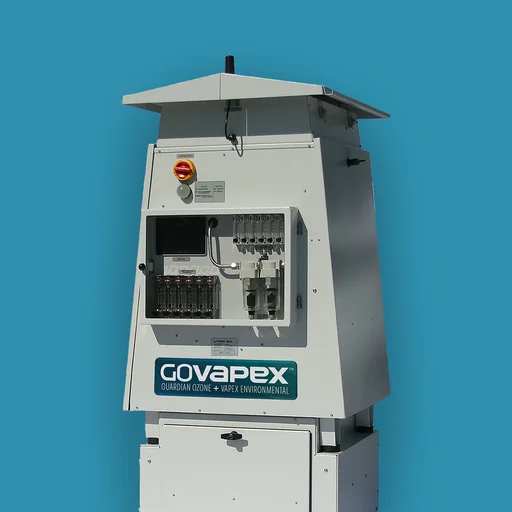
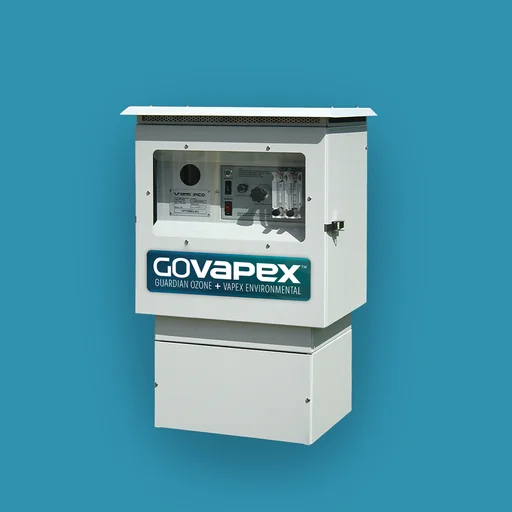
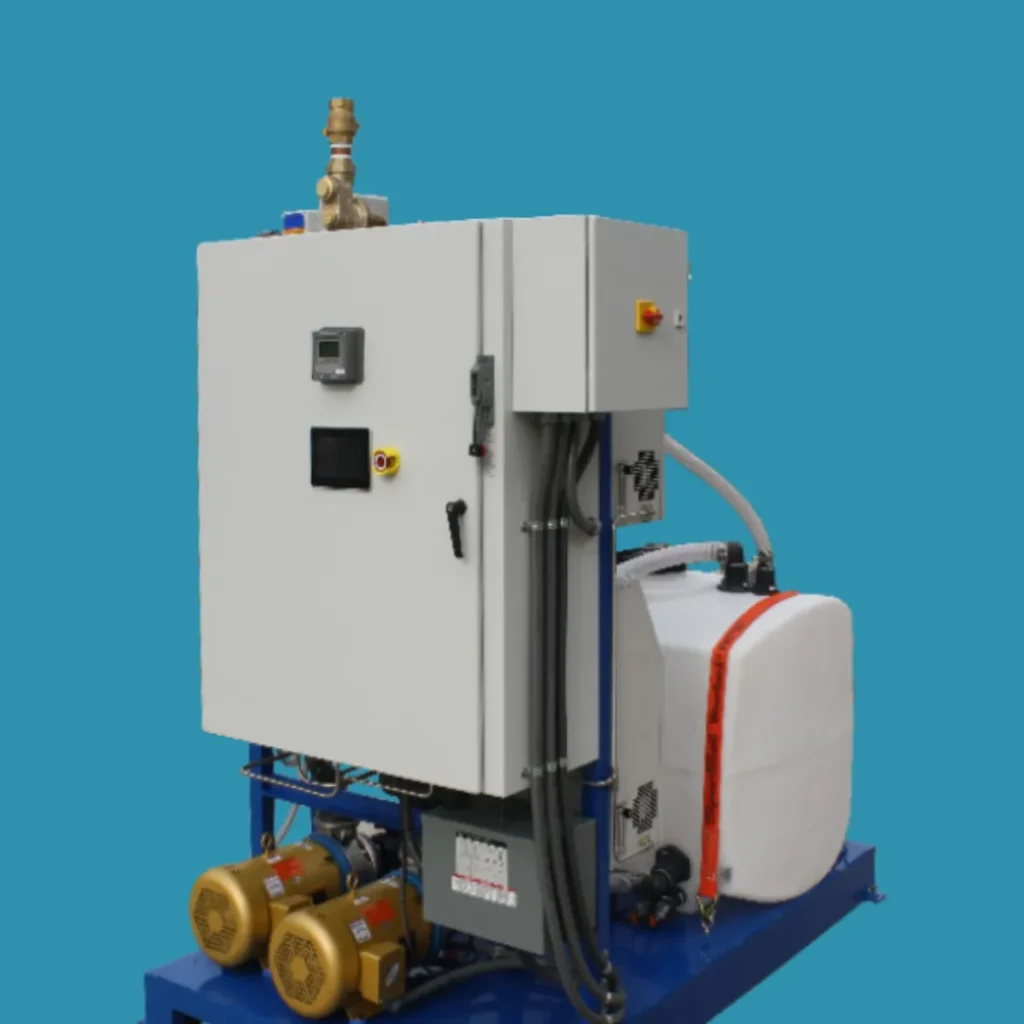
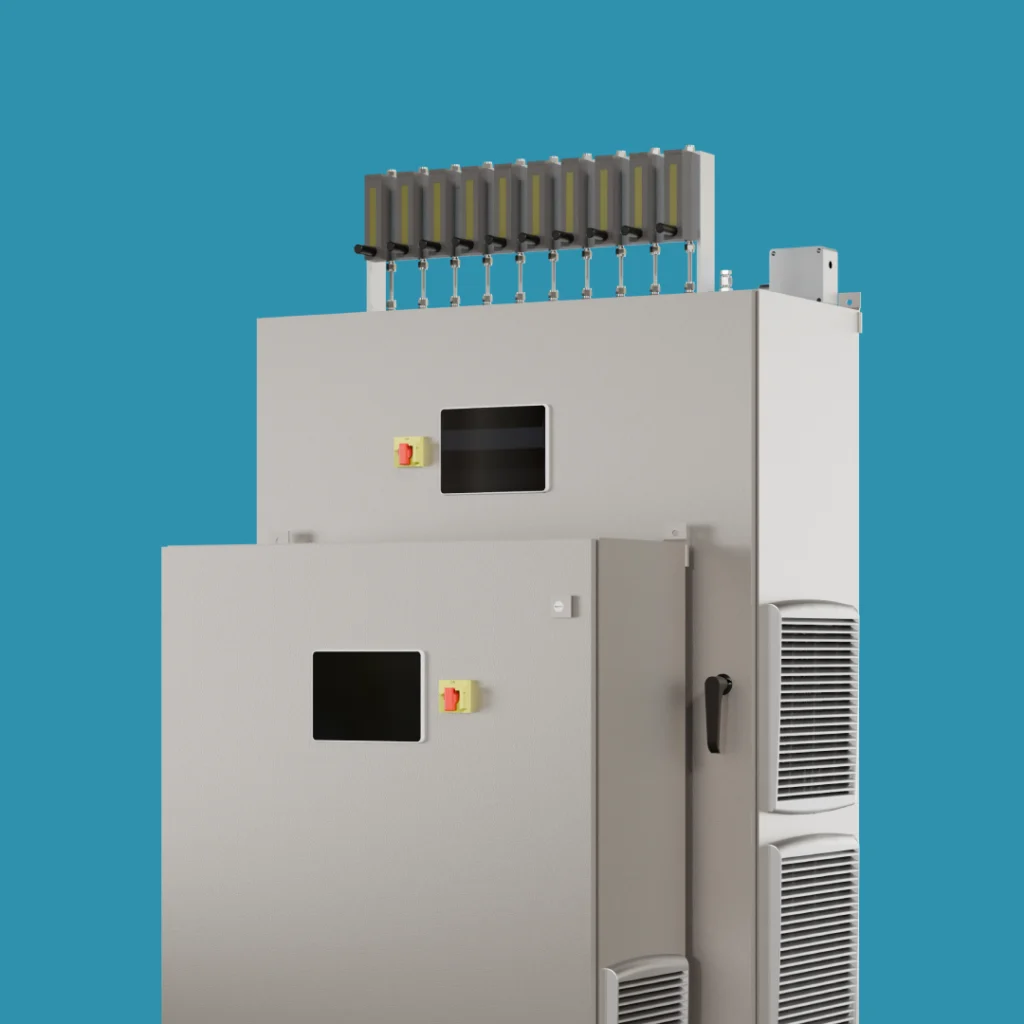
This is why GOVAPEX integrates precision regulators, flow meters, and dryer filters inside the cabinet, as shown in Figure 2 .
Field Example: Nozzle Efficiency Impact at a Municipal Lift Station
A municipality operating a 1,200 ft force main saw headspace H2S levels between 45–90 ppmv.
A GOVAPEX system with an LV Nozzle was installed.
Initial results:
Within 24 hours, H2S stabilized at <0.2 ppmv.
However, three months later:
H2S spikes reappeared. Investigation showed:
- One water groove was partially obstructed by mineral buildup.
- Air ports were partially restricted.
After performing the prescribed monthly cleaning:
- Droplet formation returned to normal.
- H2S again dropped to <0.2 ppmv.
This field example demonstrates the direct relationship between nozzle cleanliness and oxidation performance.
Nozzle Failure Modes and Preventive Engineering
The LV Nozzle is highly durable, but certain operational conditions can reduce performance.
Common failure modes include:
- Mineral scaling from hard water
- Misalignment of the oxidant tube during reassembly
- Water intrusion into the 2″ conduit when improperly installed
- Over-tightening the nozzle locking nut
- Incorrect cleaning method (non-approved tools)
Preventive measures:
- Use potable water
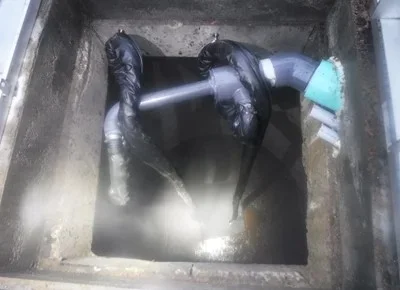
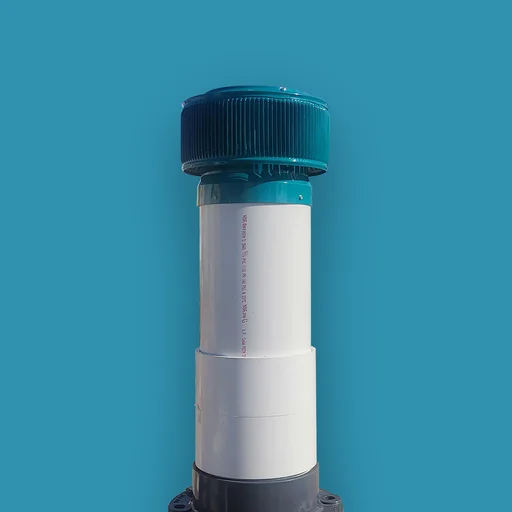
- Maintain proper conduit slope and sealing practices (Figure 1)
- Follow cleaning schedule
- Replace O-rings during filter change intervals
Why the LV Nozzle Enables Decentralized Advanced Oxidation
Decentralized stations require treatment that is:
- Compact
- Automated
- Low-maintenance
- Chemical-free
- Effective in confined air volumes
- Compatible with harsh environments
The LV Nozzle provides the enabling mechanism for all of these advantages. Its ability to create a controlled radical fog allows advanced oxidation to occur without high energy blowers, chemical storage, or large scrubber vessels.
Furthermore, by applying oxidant directly into the airspace, not through ducting or air extraction, the nozzle ensures continuous H2S destruction inside the structure rather than simply treating exhaust air.
This prevents odor complaints and corrosion simultaneously.
Conclusion
The LV Nozzle is the critical interface between oxidant generation and airspace treatment in GOVAPEX systems. Its multi-fluid atomization design creates the fine hydroxyl-rich mist necessary to neutralize hydrogen sulfide and VOCs rapidly and completely. Through precise geometry, controlled pressures, and engineered flow paths, the nozzle ensures uniform oxidant dispersion, high reaction efficiency, and reliable performance in lift stations and wastewater structures.
For decentralized odor control applications, where simplicity, automation, and compact footprint matter most, the LV Nozzle enables GOVAPEX systems to deliver consistent, chemical-free odor and corrosion control across municipal and industrial wastewater networks.